
The 2026 World Cup may have finished, but the ETF competition still rumbles on. And while the European ETF market is growing faster than the US in percentage terms, the US is still about four times larger. Investors should expect Europe to converge with the US on product structure well before it does on size.
How big is the gap?
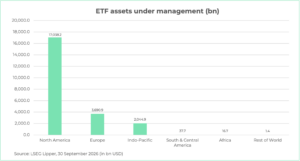
The global ETF market stood at $22.8 trillion at the end of September, down on its August high. However, this owed to poor market performance rather than negative inflows.
US-listed ETFs account for approximately $16.3 trillion of the global market, while assets under management in European-listed ETFs represent almost $3.7 trillion.
Market structure
The US market is more concentrated and domestic. The three largest providers hold around 70% of US ETF assets, with a strong home-country bias in terms of asset allocation.
That said, US product innovation continues to push new boundaries. Recent launches include leveraged single-stock ETFs, outcome-oriented ETFs, narrow thematic exposures, and now even sports teams and franchises.
Europe meanwhile leans heavily towards traditional strategies, with fixed income and equity ETFs making up around 95% of total assets under management. A closer look reveals some interesting trends, however. Active ETFs, while still only around 3% of the total European UCITS market, are growing at an impressive speed. In the eight months to August, they attracted $34 billion – more than in all of 2025.
Can Europe catch up with the US?
Not in size, at least not soon. In relative terms, European ETFs grew 40% in 2025 against 30% for the global market. Yet in absolute terms, the gap between Europe and the US remains significant (see chart).
Structural convergence looks more likely, driven by:
- Retail adoption: continental European ETF savings plans reached over 15 million in 2025, supported by various neobank and digital platform launches.
- Regulation: the Irish and Luxembourg regulators have relaxed daily portfolio transparency rules, which should help active ETF launches.
- Fixed income: active bond strategies in the ETF wrapper are still a large untapped area.
Implications for Europe
As Europe’s ETF menu widens to include more active ETFs, thematic exposures and outcome-oriented products, investors should benefit from greater choice. Asset managers stand to benefit too: these strategies generally command higher fees than traditional passive products.
However, technology and infrastructure questions also arise for asset managers. Each new fund adds to the operational load. And this is just the start. Growing demand for personalisation adds additional complexity: regional tilts, sector exclusions and rules-based overlays built for individual clients or distribution channels.
Running each of these on separate systems means duplicated data pipelines, inconsistent calculation logic, fragmented rebalancing processes and growing operational risk. This is where modern index technology platforms like PANTA matter.
Conclusion
When it comes to football, Europe is in a league of its own. The same can be said of the US in ETFs. The two markets look unlikely to draw level on size anytime soon, but we do expect them to converge on structure. That should give European investors greater choice, and favour asset managers whose infrastructure can scale as the ETF menu expands.