
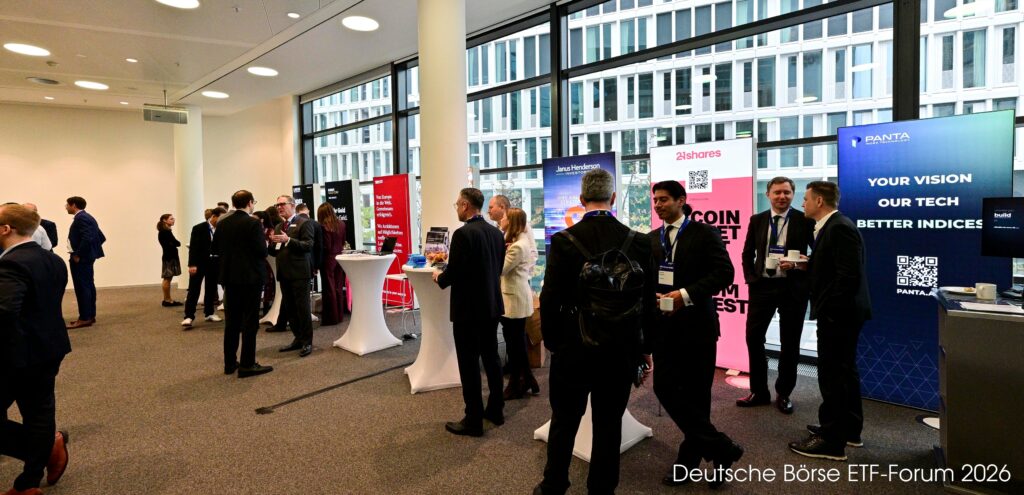
This week, PANTA had the pleasure of sponsoring and attending the Deutsche Börse ETF-Forum 2026 in Frankfurt. Across the panels and the networking, five themes stood out.
1. The fifth P of ETFs
The industry has long talked about the four Ps that shape ETF success: process, people, philosophy and performance. Platforms, meaning neo-banks and -brokers, now deserve a place on that list. They are where a growing share of investors first meet ETFs, and their interfaces, savings plans and fee models increasingly shape which products get bought. For issuers, distribution strategy now means understanding how these platforms work, not just how institutions buy.
2. Growing German retail participation
Linked to the above, Germany remains one of the most important engines of European ETF trading. Retail investors are driving volumes, helped by platforms and pension reform (see Altersvorsorgedepot). For issuers and market makers, retail flows are becoming a core part of the market’s future.
3. RFQ vs algorithmic execution
Execution was a recurring theme. The choice between request-for-quote (RFQ) and algorithmic trading depends on the size of the order, the liquidity of the underlying holdings and the urgency of the trade. RFQ can tap liquidity beyond what is visible on screen, which helps with larger or harder-to-trade orders. Algos can suit smaller, more liquid trades where control and cost matter. The lesson is that there is no single best method. Investors need to match the tool to the trade.
4. AI and tokenisation
Two technologies featured across the day. AI is being applied in areas such as index design and trade settlement. Tokenisation is also being discussed as a way to modernise post-trade processes and market infrastructure. Both are still maturing, but they are now firmly part of the conversation about how the ETF value chain will evolve.
5. Active ETFs are growing, but still small
Active ETFs were a major topic, with panels on product design, distribution and how managers can scale. Growth is clear and interest from asset managers is high, but active strategies still make up a small share of the European ETF market. Ruairidh Hill, Investment Specialist at JP Morgan Asset Management, reminded us that it’s important to separate the strategy from the vehicle: active ETFs go beyond beta and typically feature higher tracking error.
Taken together, these themes show an industry that is maturing and broadening at the same time. New channels are bringing in new investors, execution is becoming more sophisticated, and new technologies and product types are pushing the market forward. More products and more ways to access them also make transparent, well-designed indices more important to the whole ecosystem.